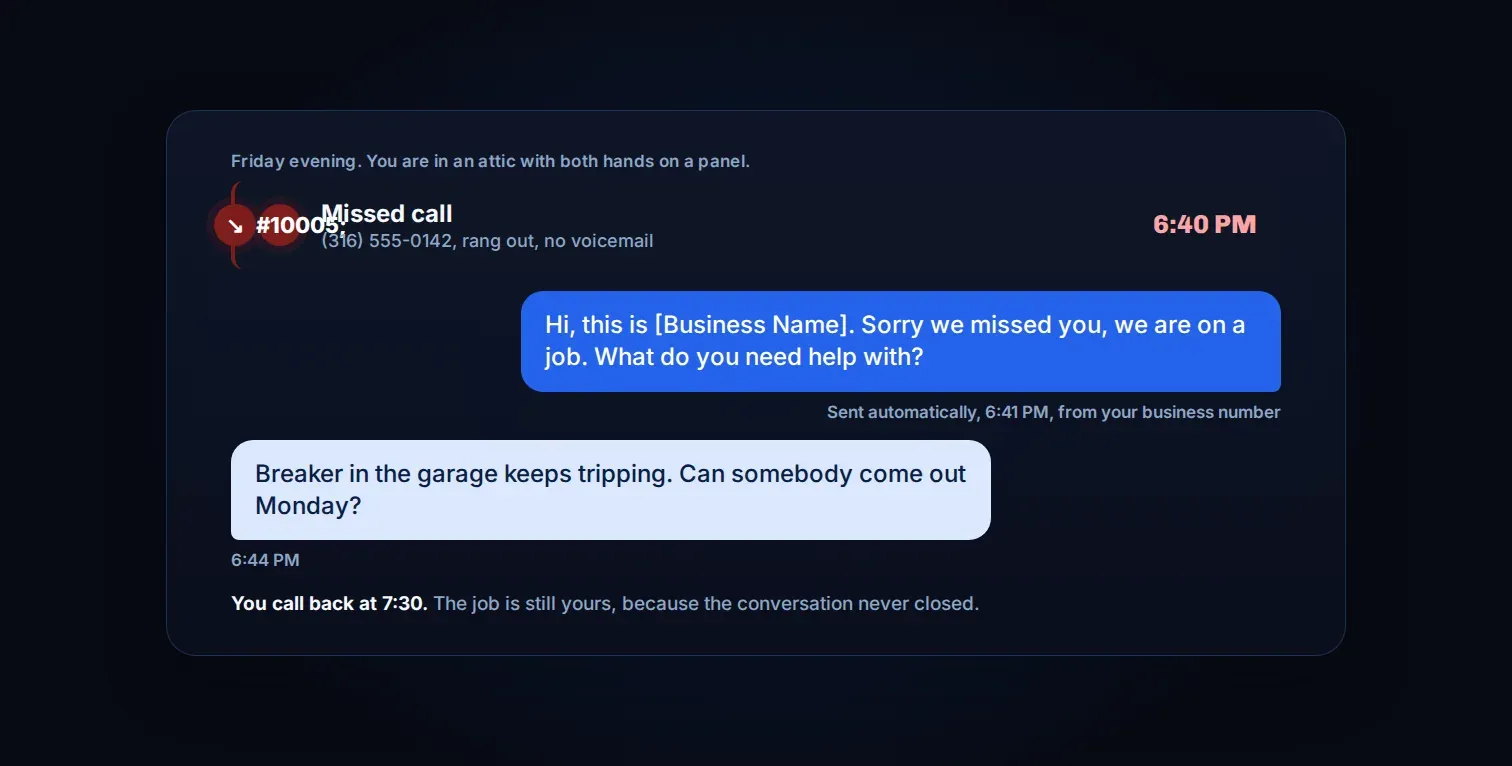
A missed call from a service business isn't a message waiting for you. It is a customer already dialing the next number. Fewer than three percent of callers who reach voicemail leave one, and most of them won't try you a second time.
That is the whole problem in two sentences. The rest of this post covers why it happens, which calls you are losing, and what to do about it when you can't answer, because for most of the day you can't.
Why voicemail stopped working
Twenty years ago a homeowner who got your voicemail left a message and waited for the callback. That is not how anyone uses a phone now.
A homeowner with a breaker that keeps tripping searches "electrician near me," taps the first number, and if a person doesn't pick up they tap the second one. The voicemail greeting is the signal to move on. They aren't being rude. They have three more numbers on the screen and they want the problem handled today.
So the voicemail box fills with robocalls and the real customers leave nothing behind. You check it, find nothing, and assume the missed calls were junk. Some of them were. A lot of them were jobs.
The three numbers worth knowing
- Only 52% of callers to home services businesses reach a person on the phone. Roughly half of every call to your trade goes unanswered somewhere.
- Fewer than 3% of callers who reach voicemail leave a message. Voicemail isn't a safety net.
- 45% of phone leads convert on the call when the conversation actually happens. The call is where the job gets won, which is why losing it costs so much.
Put those together and the shape is clear. About half the calls to your trade get missed, almost none of the missed ones leave a trace, and the calls that do connect close at a high rate. The gap between a missed call and an answered one isn't a small edge. It is the job or not the job.
Which calls you are losing
Not the ones during business hours when you are at the desk. Those you answer.
You are losing the ones that come in while you are in an attic with both hands on a panel, on a ladder, driving between jobs, or sitting down to dinner at 6:40 on a Friday. Evening and weekend calls are the ones most likely to be lost entirely, and they are also the ones where the homeowner is standing in the problem and ready to book.
An answering service catches some of this during the day. Most of them don't cover the evening and weekend calls, which is exactly where the loss concentrates.
What a good response looks like when you can't pick up
The fix isn't answering every call. Nobody can. The fix is making sure a missed call gets a response within about a minute, from your number, that gives the caller something to do.
A text that just says "Sorry we missed your call" doesn't do it, because it gives them nothing to act on and they move on anyway. A text that holds the conversation open has three parts.
- It explains why you didn't answer. "We are on a job" tells a stranger you are busy working, not ignoring them. That is the difference between a business that reads as booked and one that reads as gone.
- It hands them something to do. A question they can answer with one thumb, and a booking link as soon as they reply, so they can put themselves on your schedule without waiting for a callback.
- It goes out within about a minute. Before most callers have finished deciding whether to try the next number, while the job is still fresh in their head.
Here is the version we set up for clients:
Hi, this is [Business Name]. Sorry we missed you, we are on a job. What do you need help with?
Short, from the number they just dialed, and it ends in a question.
How it runs automatically
Our missed call text back tool watches for one event: an inbound call that ended without a person answering. Rang out, went to voicemail, hung up at the fourth ring, came in while you were already on another call. If you pick up, nothing sends. There is no scenario where a caller talks to you and then gets a text apologizing for missing them.
Your number doesn't change. The number on your truck, your Google profile, and every yard sign stays exactly as it is. What changes is what sits behind it: calls route through a line that can see a call ended unanswered, then forward straight to your phone the way they always did.
The questions owners ask before turning it on, answered plainly:
- It does not answer your phone for you or pose as a receptionist. The call itself is always yours to take.
- Your voicemail stays exactly as it is.
- Repeat calls inside the window don't re-fire. One text, no matter how many times they call.
- A landline caller still shows as a missed call on your phone. They just can't receive the text.
- STOP is honored immediately and permanently.
- If your business number is your personal cell, carriers don't allow automated texts from an active personal line, so we set up a dedicated business line that forwards to your phone. Your personal number stays personal.
- Business texting has to be registered with the carriers before it will reliably deliver. That takes days to a couple of weeks and it isn't ours to speed up, so no date gets promised that isn't ours to keep.
A form submission is a different trigger. If they fill out your site form instead of calling, speed to lead is the tool that covers that one.
Check your own business this week
- Pull up your call log for the last two weeks and count the missed calls. Then count how many left a voicemail. The difference is the number of people you never heard from.
- Note what time the missed calls came in. If most of them are after five or on weekends, that is where the loss is.
- Call your own business number from another phone after hours and listen to what a customer hears. Then time how long until anyone would have known that call happened.
- If your business number is your personal cell, note that too. It changes what is possible.
We run this exact check as part of the free teardown. We call your listed number after hours and record what happens, then look at your Google profile, your site, and your form. It runs on public information, nothing is requested from you, and it is delivered on a call.