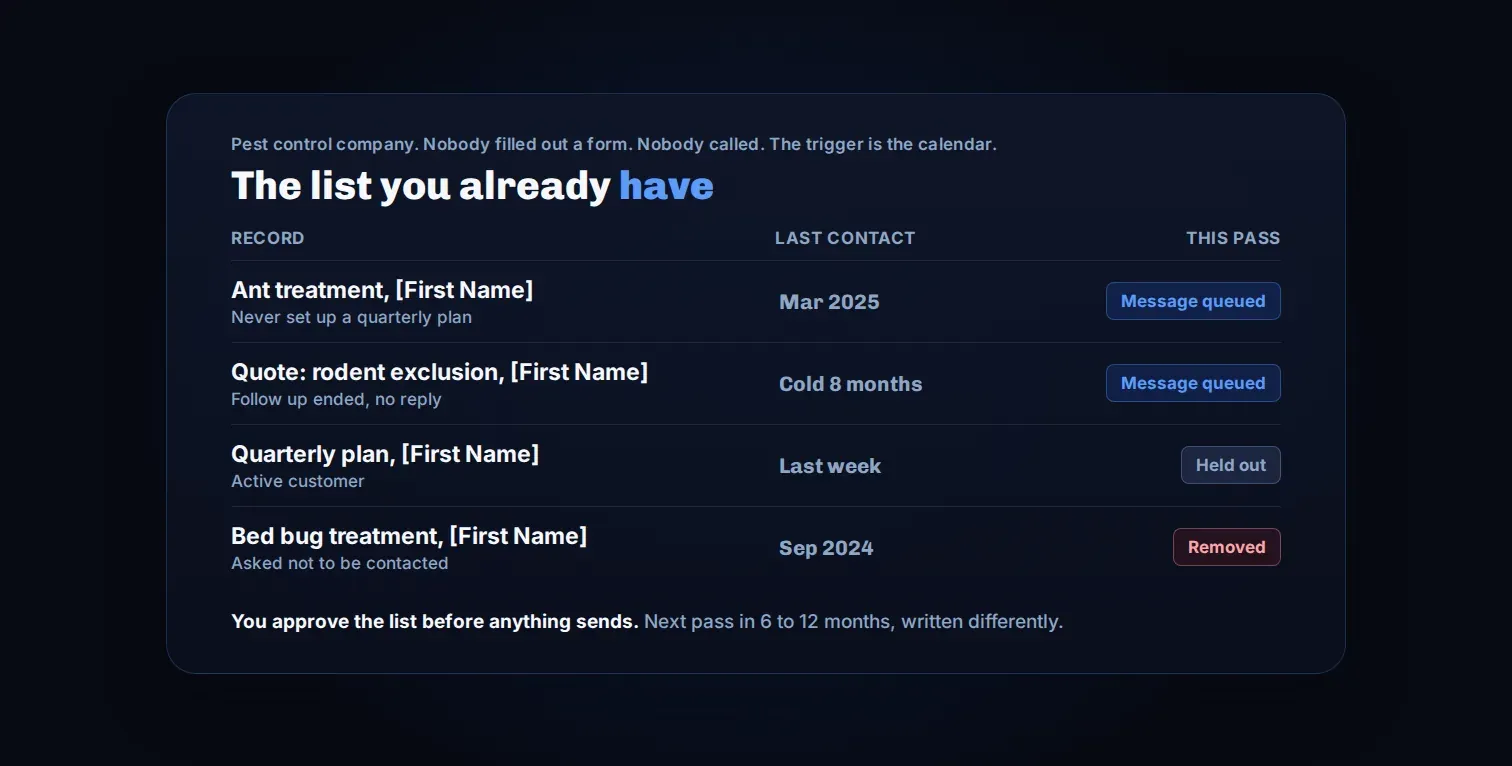
Once or twice a year, send one short message to the customers who haven't heard from you, name what they bought and roughly when, and ask if they want on the schedule. That is the whole method. It works because those people already know who you are, which is the entire difference between this and advertising to strangers.
This post covers which records you are sitting on, why nothing in a normal follow up system ever touches them, what the message should say, and the two rules that keep a reactivation pass from getting your business reported.
The list you already have
Every service business is sitting on a list it never touches. Two kinds of records are on it.
The first is quotes that went cold months ago. Somebody asked for a price, you sent it, the follow up ran its course, and nothing happened. Those records aren't wrong. They just don't have anything attached to them anymore.
The second is past customers whose service is due again. A pest control company treats a house in March and the customer never sets up a quarterly plan. By the next spring, the ants are back and the customer is searching "exterminator near me" like they never met you.
Nothing is wrong with either record. They just have no event attached to them, so nothing in a normal follow up system ever fires on them. A form submission triggers a text. A missed call triggers a text. A finished job triggers a review request. An old customer sitting quietly in your records triggers nothing.
Why this is where the money already is
Two figures we keep on hand for this:
- 53% of contractors now put existing customer value ahead of new acquisition, against 31% who still weight new acquisition higher. Most of the trade has already figured out that a past customer is cheaper to win than a stranger.
- 87.5% of top revenue contractors run a program that brings past customers back, against 68.7% of everyone else. The businesses at the top are more likely to be working their list, not less.
The gap between those two groups isn't a new marketing channel. It is whether anyone is asking the people who already said yes once.
What a reactivation message looks like
One message. Short, specific, and anchored to when they last dealt with you.
Hi [First Name], [Your Name] at [Business Name]. We treated your place for ants back in spring of last year. Those tend to come back around this time. Want me to get you on the schedule?
Three things doing the work:
- It names the job and roughly when it happened. Naming the ant treatment and putting a season on it is what separates this from a blast to an old list.
- It carries the business name. A message to somebody who hasn't heard from you in a year is exactly the message that gets reported when it arrives anonymous.
- It has an opt out. Stated plainly, and honored immediately.
Whether a pass carries an offer is entirely your call. A reason to come back isn't the same thing as cutting your price.
The two rules that keep you from getting reported
First, never send the same message twice to the same person. A pass runs every six to twelve months, and the list refills on its own in between as more quotes age out and more customers cross the interval where service comes due again. Each pass is written differently, because the same message a cycle apart is how a business gets reported instead of remembered. Twice a year is the ceiling. A list worked harder than that stops being a list.
Second, only send to people who already contacted you. It runs on your own customer records only. Nothing purchased, nothing scraped, and nobody in it who never reached out to you in the first place. Everyone on the list has to have opted in somewhere you can point to. Past customers and people who asked you for a quote usually clear that bar. A list you bought doesn't, and we won't send to one.
The first pass is a discovery run
Worth being plain about this. Years of jobs leave disconnected numbers, typos, people who moved, and customers who already asked to be left alone. Sending into that without checking it first is how a business ends up filtered and harder to reach for everybody, including the customers it is trying to keep.
So before a pass goes out, the list gets checked against opt outs and known bad numbers and addresses, and the send runs in batches rather than all at once, so a problem surfaces on the first batch instead of the last. Dead records come out of the list rather than being retried.
Even a pass with no replies still gives you something. It usually means the records are thinner or older than expected, and that shapes what the next pass looks like. The second pass is written against what the first one showed.
How it runs
Our lead reactivation tool is the only one in the system that doesn't fire on something the customer did. The other four react to an event. This one goes looking, on the calendar.
The questions owners ask before turning it on:
- You approve the list before anything sends. You see who is on it and what it says, every time it runs.
- Active customers and open jobs are always held out of a pass. Only aged records get worked.
- Anyone contacted on the previous pass is either held out this time or written to differently.
- A reply that is irritated at being contacted always lands with you, never with an automation. That record comes off the list.
- A quote you sent last week isn't reactivation. It belongs with email follow up, which is a different tool.
- It runs on whatever list size you have. What matters is whether the records carry a working number and enough job detail to say something specific.
- Business texting has to be registered with the carriers first, so the first pass happens once that clears rather than on a promised date.
Some people will be annoyed. That is a normal outcome. The bigger risk runs the other way: a customer forgets your name and hires whoever shows up in search when the next thing breaks.
Check your own business this week
- Count the customers in your records who haven't heard from you in a year. Not the ones you remember. The ones in the file.
- Count the quotes older than three months with no reply. Those are the second half of the list.
- For each record, ask whether you could say what they bought and roughly when. If the answer is no, the record can't produce a message worth sending yet.
- Look at where your repeat work is coming from now. If the answer is "people who happen to remember us," that is the gap.
We look at this as part of the free teardown, along with your Google profile, your site, your form, and how an after hours call gets handled. It runs on public information, nothing is requested from you, and it is delivered on a call.