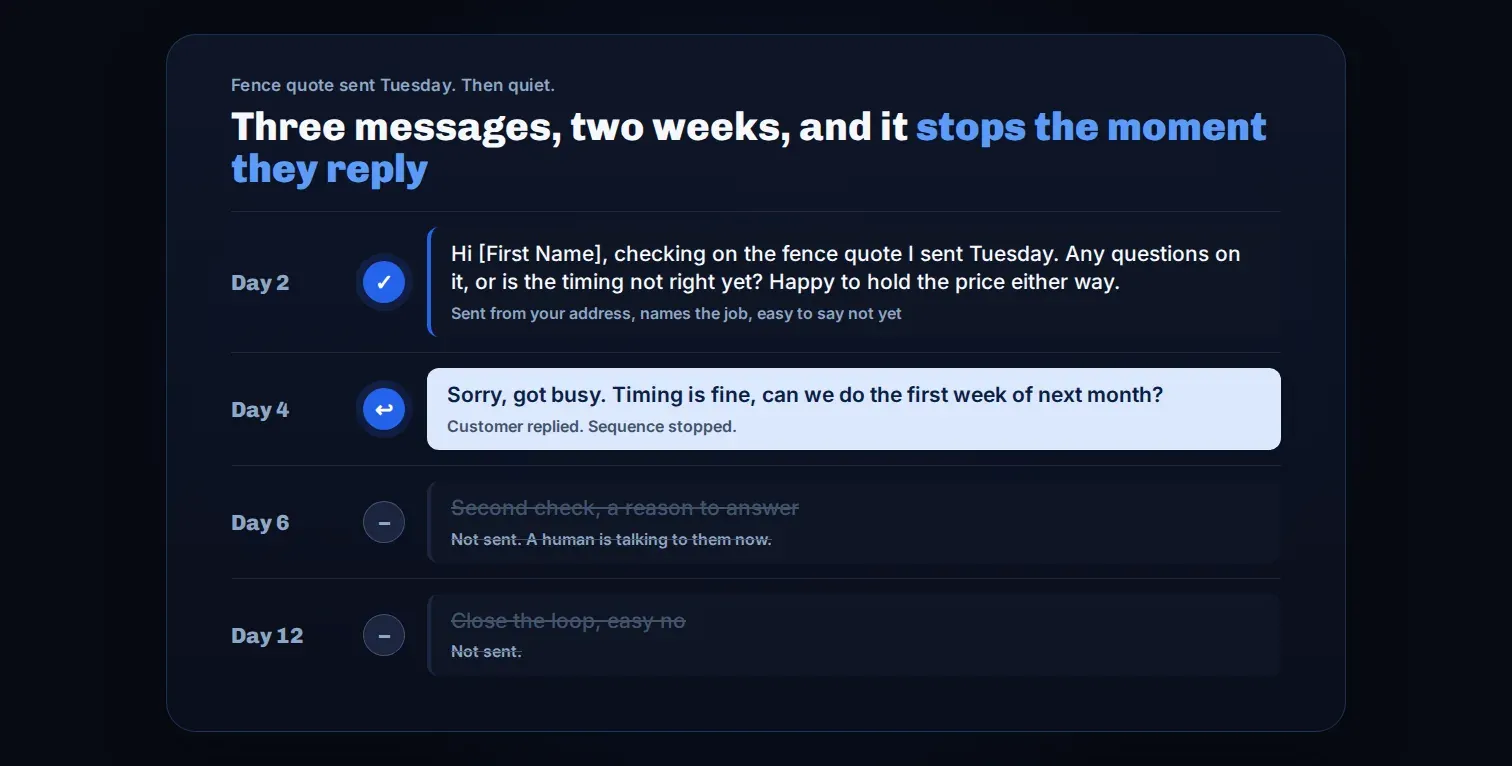
Three short messages over about two weeks, each one asking a question, and the whole thing stops the moment they reply. That is what professional follow up looks like. It isn't begging, and it isn't a newsletter. It is the part of the sale most service businesses skip entirely.
This post covers why quotes go quiet, what the follow up should say, how many messages is the right number, and where the line is between following up and becoming the reason someone marks you as spam.
The quote is the most expensive thing you produce
A fence contractor gets a call, drives out, walks the property line, measures, prices it, writes it up, and sends it. That is an hour or two of the owner's time and a tank of gas, before a dollar comes in.
Then it goes quiet. The homeowner got three quotes, one of them was yours, and now they are busy. They didn't say no. They just didn't say anything.
Most owners never touch that quote again, because a second message feels like pressure and a third feels like desperation. So the most expensive thing the business produced sits in a sent folder until it is forgotten.
Silence usually isn't a no
Most people who go quiet after a quote aren't gone. They got busy, the other quotes haven't come in yet, a spouse hasn't looked at it, or the timing slipped. A quote with no follow up asks them to remember you on their own, in the middle of everything else.
Two figures on this, and a third that shows what good looks like:
- A single long follow up message pulls the lowest response rate in a dataset of over 132,000 campaigns. One big email, sent once, is the worst shape.
- Real follow up sequences average a 60% response rate. Several short messages, spaced out, and more than half of people answer.
- The best built sequences reach response rates as high as 90%, built as seven short messages over seven days. Short, spaced, and each one easy to answer.
The pattern across all three is the same. Short beats long, several beats one, and a question beats a statement.
What a follow up message should say
Short, plain, and from you, not from a marketing department. It names the job, so it doesn't read as a blast to everyone who ever got an estimate, and it gives the customer an easy way to say not yet.
Hi [First Name], checking on the fence quote I sent Tuesday. Any questions on it, or is the timing not right yet? Happy to hold the price either way.
Three things doing the work in that message:
- It names the job. "The fence quote" tells them exactly which decision this is about.
- It offers an easy no. "The timing isn't right yet" is a real answer you can work with. Silence isn't.
- It holds the price. That removes the one reason a homeowner might avoid replying, which is worrying the number went up.
How many messages, and when to stop
Three messages spread over about two weeks, then it ends.
Roughly: a short check two days out, a second around day six that gives them a reason to answer, and a last one near day twelve that closes the loop and makes it easy to say no. The exact spacing depends on the trade, because a drain clog decision and a fence replacement decision run on different clocks.
There is no fourth message. A sequence that keeps going past two weeks stops being follow up and starts being the reason people mark you as spam. A clean no at the end is worth more than a maybe you chase for a month.
The single most important rule: the sequence stops the moment they reply. Nothing queued behind it sends. Someone who answered on day two never gets the day six message, because at that point a human is talking to them and the automation is done.
Why this is the one part of the system that works on day one
Business texting has to be registered with the carriers before automated texts will reliably deliver, and that registration takes days to a couple of weeks. Email has no such gate.
That makes email follow up the first thing that produces a booked job on a new build, because it runs from launch. Once texting registration clears, a text goes out on the second touch as well, and it lifts replies noticeably.
How it runs automatically
Our email follow up tool attaches to one thing: the quote going out. When the estimate is sent, the sequence starts counting from that day. One quote, one sequence, one person. A customer who gets two quotes from you for two different jobs is in two separate sequences, because they are two separate decisions.
The questions owners ask before turning it on:
- Booking closes the quote, and the sequence stops right along with it.
- If they reply once and go quiet again, that quote is yours for good. The automation doesn't restart.
- A bounce stops sending to that address rather than retrying it, which is what keeps the rest of your list reachable.
- Unsubscribing is honored permanently for that address. They stay a customer either way.
- It doesn't negotiate and it doesn't set pricing. It asks a question, and you are the one who answers it.
- On a large job, call. This catches the ones you would never have gotten around to calling.
- Anyone who didn't get a quote isn't in it. A quote that went cold months ago belongs with lead reactivation, which is a different tool.
Check your own business this week
- Open your sent folder and count the quotes from last month. Then count how many got a reply of any kind. The gap is the number of decisions you are waiting on with no follow up.
- For each quote with no reply, note whether you sent anything after it. Most owners find the answer is nothing.
- Pick the three most recent quiet quotes and send the message above, by hand, today. Name the job, ask a question, hold the price.
- Note what comes back. Even a no tells you something the silence didn't.
We walk this same path as part of the free teardown: from the quote going out to the job getting signed, along with your site, your form, your Google profile, and how an after hours call gets handled. It runs on public information, nothing is requested from you, and it is delivered on a call.