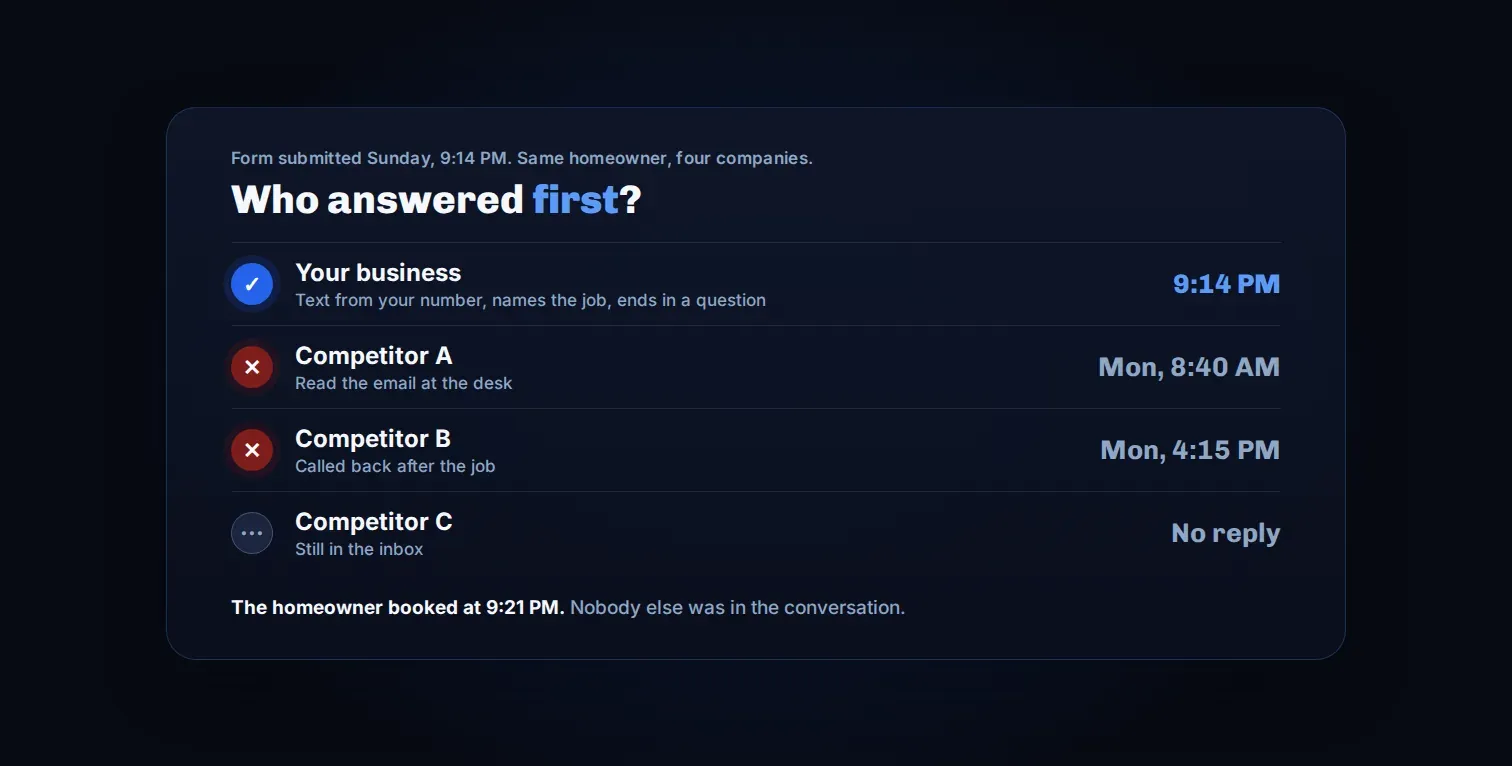
Within five minutes, and sooner if you can. That is not a stretch goal. It is the window a homeowner gives you before they move to the next name on the list, and it applies to a form submitted at nine on a Sunday night the same as one submitted at ten on a Tuesday morning.
Most service businesses answer in hours or the next day, and they lose jobs they never knew they were competing for. This post covers why the window is that short, what it costs when you miss it, and what you can do about it without carrying your phone into every crawlspace.
Why the window is five minutes and not an hour
A homeowner with a leaking roof does not fill out one form. They open three or four sites in a row and submit to all of them in one sitting, because they want the problem handled and they don't know which company will actually respond. Then they set the phone down.
The first company to write back gets the conversation. By the time the second one replies, the homeowner is already answering questions for the first one, and by the time the third one replies there is an appointment on a calendar.
Nobody is choosing the best roofer in that moment. They are choosing the one who showed up.
What the numbers say
- 88% of contractors don't answer a new lead within five minutes. The single most common response time is a full day.
- You are 21 times more likely to qualify a lead at five minutes than at thirty. Not twice as likely. Twenty one times.
- Only 3% of contractors answer a lead in under a minute. That is the group that wins the hire, and it is a small group.
Read those together and the picture is plain. Almost everyone is slow, being fast is rare, and the payoff for being fast is large because so few businesses are doing it.
Why you are slow even when you are good
Response time isn't a work ethic problem. Most owners we talk to reply the second they see a lead. The problem is when they see it.
A roofer is on a roof. A tech is under a sink. An owner is doing invoices at nine at night and has the email tab closed. Form leads arrive during exactly those hours, because homeowners search for help after work and on weekends, and the reply that decides who gets hired has to happen inside minutes.
"I reply as soon as I can" is true, and it is also the gap. The lead doesn't wait for your next free moment.
What a fast reply actually needs to say
Speed alone isn't enough. An auto-reply that says "Thanks for your inquiry, we will be in touch" gets read and set down, because it gives the homeowner nothing to do. A reply that keeps the conversation open looks different.
- It names the job. "Got your request about the storm damage on the roof" tells them a person set this up for a roofing business, not a form vendor.
- It ends in a question. "Is water coming in right now, or is it the shingles you can see from the yard?" A question gets an answer, and once they have answered you are in a conversation instead of a queue.
- It comes from your business number. The same number on your truck and your Google profile, so it isn't an unknown area code they ignore.
You can write this by hand if you are free. The point is that you are usually not free, which is where the tool comes in.
What happens when it is automatic
Our speed to lead tool sends that text the moment the form lands, from your business number, before the homeowner has closed the tab. It runs at three in the morning on a Sunday the same as it does at two on a Tuesday.
When they answer, the reply lands in the same text thread as the rest of your conversations, and a booking link goes out so they can put themselves on your calendar without a phone call. When you are free, you pick up the thread where it left off. If they have already booked by then, there is nothing to catch up on.
A few things owners ask before turning this on, answered plainly:
- You can take over the conversation at any time. The text holds the spot open until you are free. It does not run the job for you.
- If they typo their own number, the email version goes out at the same time and one of them lands.
- If they submit the form twice, they still only get one text.
- STOP is honored immediately and permanently. That is carrier rule, and it is handled.
- Bot and spam submissions never reach your phone. The form carries a hidden trap field and a timing check, and every request is checked again before it reaches your CRM.
If the homeowner calls instead of filling out a form, that is a different signal and a different tool. Missed call text back covers that one.
Check your own business this week
You don't need us to find out where you stand. Do this once and you will know.
- Fill out your own contact form from your phone, after hours, and time what comes back. Write the time down.
- Look at where that form submission landed. Email, a CRM, a text, nowhere.
- Count the form leads from the last month and ask how many got a reply inside five minutes. Be honest with yourself.
- Note the three companies above you in search and ask if a homeowner who submitted to all four of you would have heard from you first.
If the answer to the last one is no, that is the job you are losing, and it is losing to the same competitors every time.
We run this exact check as part of the free teardown. We fill out your form and time what comes back, then look at your Google profile, your site, and what happens when someone calls after hours. It runs on public information, so there is nothing you need to send us, and we walk you through what we found on a call.