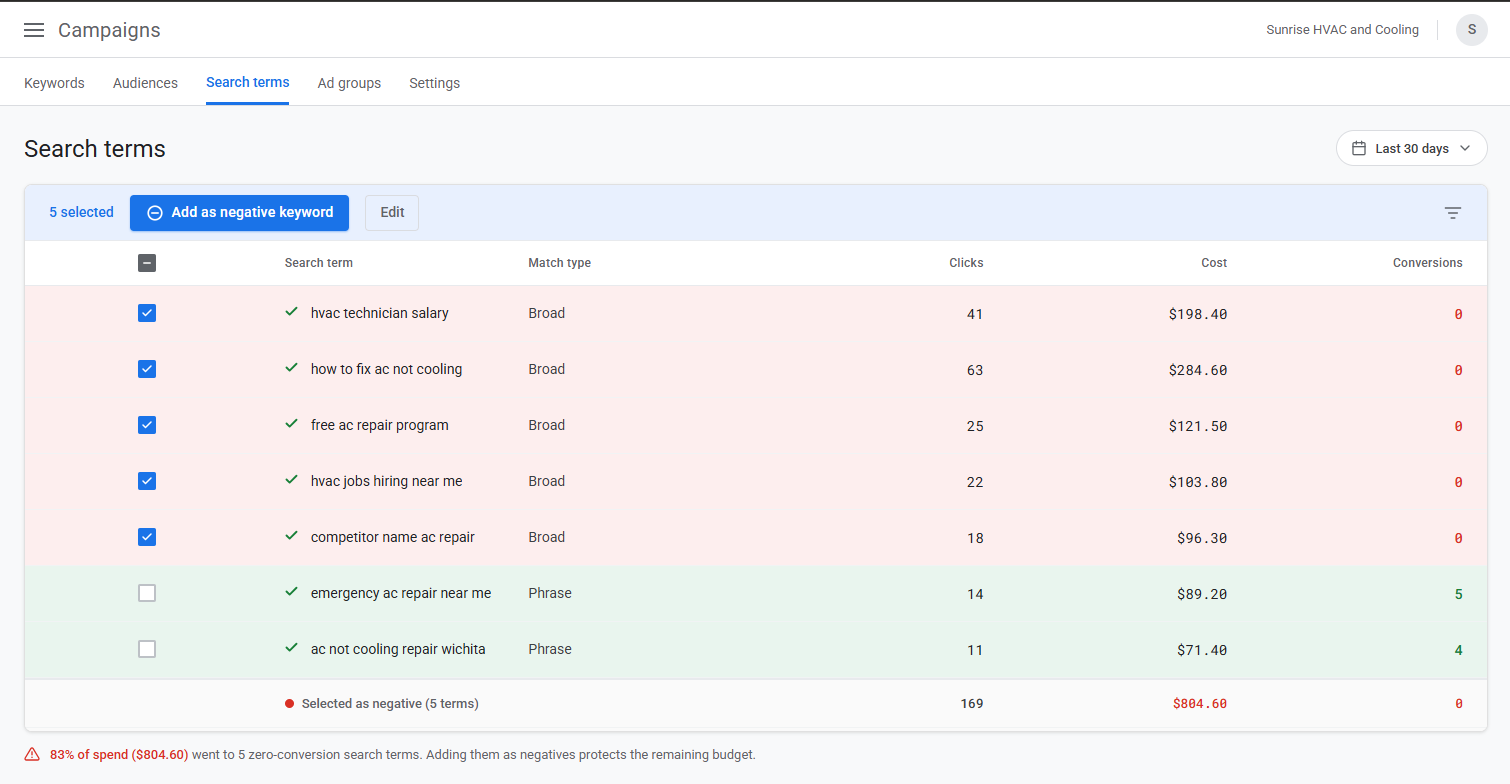
If you run Google Ads for a local service business and the budget disappears faster than the leads show up, the leak is usually not where you think. It is rarely the headline, the bid, or the landing page. It is the searches you never chose to pay for and never saw. The setting that controls those is called negative keywords, and it is the difference between an ad account that works and one that burns cash on people who were never going to call.
First, what negative keywords actually are
Negative keywords are a Google Ads feature. They are a list of words and phrases that tell Google, "do not show my ad when someone searches for this." That is the whole idea. A regular keyword tells Google when to show your ad. A negative keyword tells Google when to stay quiet.
Worth being precise here, because this trips people up: negative keywords live inside a paid Google Ads account. They are not part of your Google Business Profile, and they have nothing to do with how you rank organically on Maps or in regular search results. If you are not paying for ads, you do not have negative keywords, and you do not need them yet. Hold that thought, because it matters later.
How the leak actually happens
When you add a keyword to a campaign, you are not telling Google to match that exact phrase. Depending on your match type, and especially on the broad match setting Google turns on by default, you are telling Google to show your ad for anything it decides is related.
That word "related" is where the money goes.
Say you run an HVAC company and you bid on "ac repair." Reasonable keyword. Here is a sample of what Google may decide is related and charge you for:
- ac repair salary
- how to fix ac not cooling
- hvac technician training near me
- hvac jobs hiring
- free ac repair program
- a competitor's name, plus ac repair
Every one of those is a click you pay for. Not one of them is a customer. The person searching "ac repair salary" is deciding whether to become an HVAC tech. The person searching "how to fix ac not cooling" is standing at their outdoor unit with a multimeter and no intention of hiring anyone. The person searching a competitor's name has already made up their mind, and you just paid to remind them of it.
Multiply that by every keyword in the account and every day the campaign runs, and that is the leak. It is quiet because Google never sends you a bill that says "wasted." It just spends the budget, and the leads do not come.
The patterns, not a checklist
The specific junk terms are different for every trade, so a copy-paste list is close to useless. What is useful is recognizing the patterns, because they repeat across almost every local service business:
- Job seekers. "salary," "jobs," "hiring," "careers," "training," "apprenticeship." People looking to work in your trade, not hire it.
- DIY and free. "how to," "DIY," "free," "cheap," "grant," "program." People who will fix it themselves or want it done for nothing.
- Wrong service. You do AC and heating, they searched "refrigerator repair." Adjacent-sounding, not you.
- Informational. "what is," "cost of," "vs," "reviews." Early researchers, worth far less than someone typing "emergency" or "near me now."
- Competitor names. Bidding on these can be a real strategy, but only on purpose, never by accident.
The work is not downloading a list. The work is reading your own search term report, the record of what people actually typed to trigger your ad, and cutting the terms that were never going to pay off. That report is where the truth lives, and most accounts never get read again after setup day.
The 2026 wrinkle makes it worse, not better
This used to be a set-it-at-launch task. It is not anymore. Google has pushed hard into automated campaign types, Performance Max and the newer AI Max, that are built to expand your reach beyond the exact signals you give them. That is the selling point and the risk in the same feature. These campaigns will happily spend across Search, Shopping, YouTube, Gmail and more, matching your ads to queries far broader than you would ever pick by hand.
The tradeoff is blunt: the more Google automates the targeting, the more your negative keyword list becomes the main steering wheel. Google also added campaign-level negative keywords in the last year, so the control is finer than it used to be, but only if someone is actually maintaining it. Automated campaigns without disciplined negatives are the fastest way to bleed a local budget in 2026.
The part nobody selling you ads will say
Here is the uncomfortable version. Negative keywords make a working ad account more efficient. They do not fix an account that should not be running.
Ads do not create demand. They amplify whatever your business already does when someone lands. If your site has no clear offer above the fold, if your contact form fails silently, if a stranger cannot tell in five seconds who you are and who you serve, then paid traffic just pours more people into a bucket with a hole in it. You will pay Google to send you leads, then lose them at the door.
And this is the honest line on where negative keywords sit versus everything else: they are a paid-ads lever, full stop. They are not your Google Business Profile, and they are not local SEO. For most local service businesses, the profile is the higher-leverage starting point, and it costs nothing. The right primary category, real reviews coming in steadily, accurate service areas, that is often where the local phone starts ringing before a single ad dollar is spent. Ads are a multiplier you bolt on once the fundamentals are solid, not a substitute for them.
So the real sequence for most local businesses is straightforward: fix the site, set up the profile, prove the fundamentals convert, then consider ads. Only at that last step does a negative keyword list start earning its keep.
The takeaway
If you are already running ads, go read your search term report this week. You will find terms you are paying for that you would never have chosen. Add them as negatives. That one habit, done monthly, separates the accounts that work from the accounts that quietly leak.
If you are not running ads yet, do not start with ads. Start by making sure the things a paid click lands on are actually built to convert. That is the cheaper fix, and it is the one that has to come first.
Our paid presence audit is built to catch exactly this. We look at whether your site, your profile, and your lead path are set up to turn attention into calls, and whether paid ads are even the right move for where your business is right now. Sometimes the answer is yes. Often the honest answer is "fix these three things first, and you may not need to pay for traffic at all." Either way, you get a clear diagnosis before you spend a dollar on clicks.